
The Data Infrastructure Blind Spot: How Fragmented Guest Data Erodes Solo Traveler Yield

Introduction
Luxury hospitality has spent years investing in PMS upgrades, CRM migrations, CDPs, RMS logic, and data-orchestration platforms. Yet the industry still overlooks a simple operational truth: the commercial engine cannot protect revenue it cannot see. For the affluent solo traveler, that blind spot affects far more than room revenue. It shapes ADR, RevPAR, ancillary spend, direct-booking conversion, loyalty value, and distribution cost across the luxury portfolio. A guest may generate premium suite revenue alongside meaningful dining, wellness, concierge, or transfer spend, but the technology stack often breaks that economic profile into isolated departmental transactions before leadership can see its full value.
The Greatest Assist’s Data & Tech Infrastructure Insights #001 exposes one structural pattern: the hotel captures solo-traveler behavior but fails to preserve the intelligence that makes that behavior commercially valuable. Without a unified profile, forecasts distort because no governed definition exists; yield disappears across separate records; and, when the guest returns, the hotel pays OTA commission to reacquire demand it has already earned.
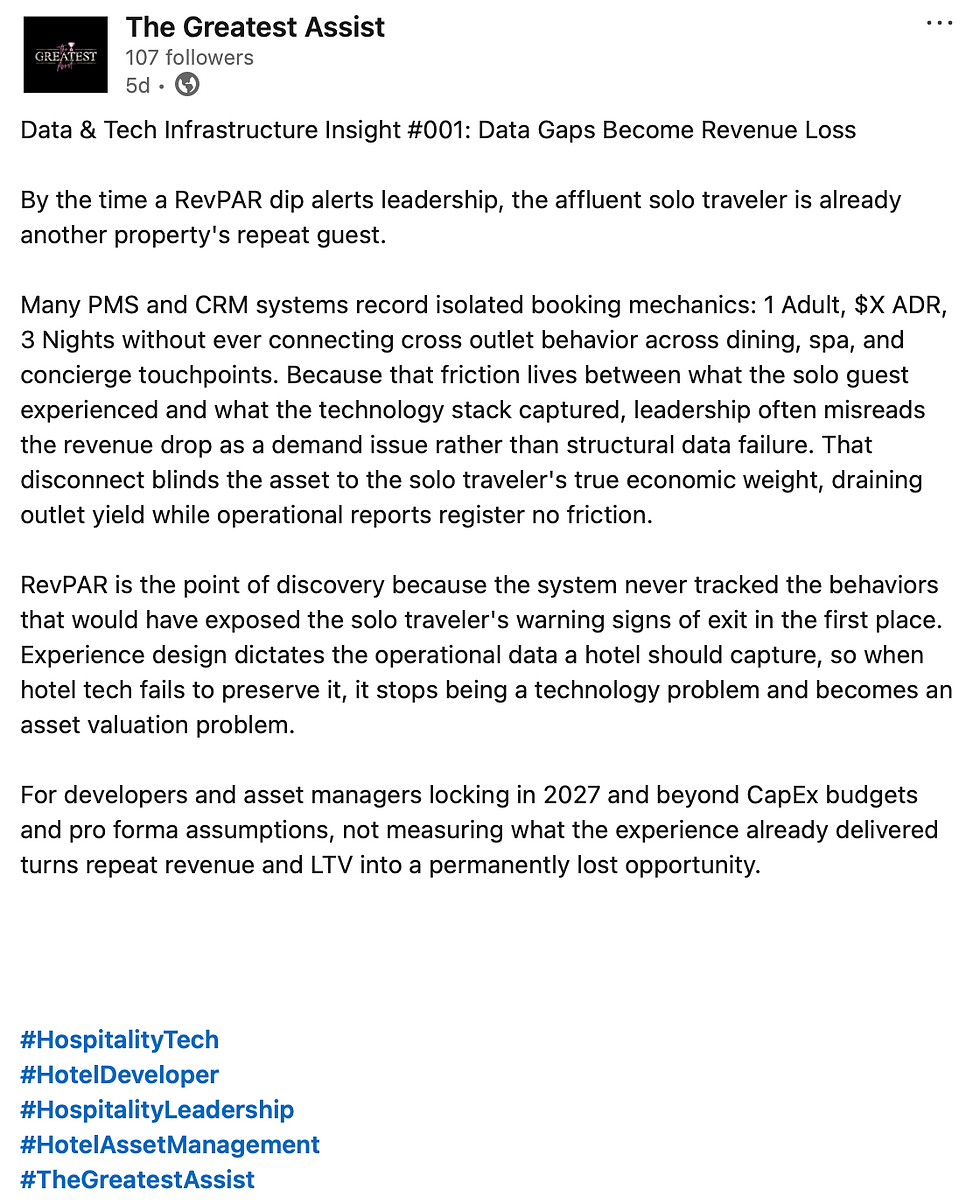
Luxury hotels either convert solo-guest data into a persistent commercial asset or allow its value to dissolve between systems, departments, and stays. When the hotel cannot recognize the guest across touchpoints, retain the full economics of the stay, and activate that intelligence in pricing, distribution, loyalty, and repeat-stay strategy, fragmentation becomes a financial loss: unrealized ADR, weaker direct demand, higher acquisition cost, and lower NOI.
Where Luxury Solo Traveler Revenue Disappears in the Data
Luxury hotels rarely lack affluent solo demand. They lack the ability to connect the data that proves its full value.
#1: The Transaction That Never Becomes a Profile A solo guest’s room, dining, wellness, and ancillary purchases are stored as separate departmental transactions rather than a unified commercial relationship. The guest appears moderately valuable across separate dashboards even when their combined contribution is materially higher. As a result, leadership sees isolated departmental revenue but loses the full-stay yield signal that should drive pricing and capital allocation. By the time the loss shows up in RevPAR, the guest is already another property’s repeat business.
#2: The Missing Definition That Distorts Forecasts Most hotels possess reservation, spend, loyalty, and channel data, but lack a governed definition of a recurring, high-value solo traveler. That gap causes solo demand to disperse across party-size fields, rate codes, and disconnected stay records. Revenue teams understate solo ADR potential, commercial teams misdirect distribution spend, and developers underwrite pro-formas without visibility into the segment's true margin contribution. The property captures the raw signal but remains unable to operationalize it in pricing, business planning, or asset valuation.
#3: The Intelligence That Does Not Survive the Stay At checkout, the hotel retains the financial transaction but loses the commercial intelligence behind it: what the guest valued, purchased, and experienced. Pre-arrival planning resets to generic, upsell offers fire blindly, and post-stay engagement fails to carry forward the guest’s true economic footprint. Without a persistent profile to trigger high-converting direct re-engagement, the guest defaults back to search or OTA channels—forcing the property to pay a second distribution tax to re-acquire demand it already earned.
Why the Luxury Solo Traveler Deserves Executive Attention
Their data profile behaves differently and that difference has commercial weight. A solo guest’s spending and decision-making are concentrated in one identifiable customer rather than distributed across multiple travelers. There is no second guest’s preference set to average into the booking, the stay, or the ancillary purchase pattern. That can make solo-traveler behavior more attributable, more legible, and more actionable provided the hotel’s commercial architecture is designed to recognize it. The luxury solo traveler is not simply a marketing persona. They are a revenue class: a guest whose booking patterns, rate tolerance, on-property choices, channel behavior, and repeat-stay potential can be connected to a single commercial profile. The properties that build this capability first will not merely market more effectively. They will price with greater precision, protect more direct demand, personalize higher-margin ancillary offers, and re-engage valuable guests without paying to acquire them again—potentially outperforming their own pro formas before the broader market recognizes the source of the gain.
The Balance-Sheet Impact on Asset Performance
The system cannot preserve what leadership never instructed it to measure. If ownership has not named solo‑traveler revenue as a commercial priority, the data architecture treats the guest as discretionary and that afterthought later appears as erosion across familiar commercial measures.
Commercial Metric | The Strategic Disconnect | Balance-Sheet Consequence |
RevPAR & ADR | Pricing algorithms evaluate solo demand as single-occupancy concessions rather than high-margin yield drivers. | Artificially suppressed room rate positioning and muted RevPAR growth. |
Ancillary Spend Capture | Outlet POS systems process standalone transactions without linking spend back to the core guest profile. | Depressed Net Operating Income (NOI) across F&B, spa, and wellness outlets. |
Customer Acquisition Cost (CAC) | The tech stack discards behavioral intelligence post-departure, forcing marketing teams to re-buy the guest. | Inflated performance-marketing costs and unnecessary customer re-acquisition expense. |
Distribution Margin | Lack of persistent re-engagement profiles causes repeat guests to default back to third-party channels. | Recurring "second distribution tax" paid to OTAs on previously secured guests. |
Pro-Forma LTV Modeling | Underwriting models fail to account for multi-stay solo LTV due to fragmented historical stay data. | Discounted asset valuations and understated return-on-equity projections for lenders. |
The Strategic Shift: From Data Collection to Intelligence Preservation
Persistent data orchestration is key to eliminating re-acquisition costs, safeguarding direct-booking value, and gaining an inevitable commercial edge before competitors understand why their profits are shrinking. Leadership should assess the organization with one question: can this property integrate what a solo guest has already disclosed, purchased, and valued into a unified commercial profile that influences pricing, distribution, and future stays, particularly before the next RevPAR report has to explain why it didn’t? Next, inquire if anyone within the organization is responsible for bridging that gap, as the chance to address this is diminishing. It is certain that the properties that close it first will establish the pricing and loyalty benchmarks that the rest of the market will need to follow.
Closing Question
If a high‑value solo traveler stayed at your hotel this week, would your system preserve their economic footprint across pricing, distribution, loyalty, and repeat stay strategy? Or would the guest disappear into disconnected records and become revenue you have to reacquire?
Diagnose Your Luxury Solo Traveler Data Infrastructure
The Greatest Assist examines where luxury hotels are losing solo traveler revenue inside their data infrastructure and where that friction may be suppressing otherwise valuable demand.
[Request an Executive Assessment] with The Greatest Assist's advisory team.

Comments